

Happy 2021
So we did it, we survived 2020. Now what?
Will you get the vaccine? Will we go back to offices, restaurants, concerts and movie theatres? When will things begin to feel like normal again? Better yet, are we expecting too much or asking the wrong questions?
It is hard to fathom that this month (January) marks a year since I first had a serious conversation with a client about “that weird virus-thing call Corona 19” and only a few weeks later, when I cancelled a meeting due to losing my voice (allergies), the meeting attendee sardonically emailed and texted with emoji’s “Oh no, do you have The ‘Rona…hahahah???” (GROAN….) It seems like a lifetime ago.
[In reality, our family actually started talking about the virus at the dinner table Thanksgiving 2019, as my husband, our son and dinner guests are all in the airline industry and they were already feeling the effects of fear, lighter flight loads and restrictions, but that is the topic of another story….].
None the less, here we are. Older, and uncertain as to wiser, but we are here. And what does this mean?
It means that hope cannot be diminished nor denied. And perseverance and ingenuity will prevail And we keep stepping forward, to engage with 2021, and the future. What that future will look like, only we have the power to create. And isn’t that part of the wonder? The joy, or better yet, the magic of living?
So go forward we must and go forward we will. Not forgetting the moments, days and in many cases, the loves and lives we have lost. But going forward honors their memories, wouldn’t you agree?
So, Happy New Year.
You not only made it to 2021, but also half way through the first month of a new and very unique, year. Let’s keep moving forward. Together.
From all the Versant advisors and staff:
Thank you for believing in us and trusting us during one of the most turbulent times in history.
It will not be forgotten.
Kathleen
Recharging
What if we recharged ourselves as often as we did our phones…..
“What if we recharged ourselves as often as we did our phones...what can we accomplish?"
Sorry, I don't have the name of the person who said this. I just remember coming across it some time ago and adding it to Evernote.
It came to mind when, after working for 15 days straight on multiple projects, my husband asked me to take a walk in the middle of the afternoon. Even though my next scheduled Zoom call had just postponed, my response was "No, I have too much to do".
He stood in my doorway, hands on hips...I relented.
As I was putting on my running shoes, I found myself fearful; like a client or my boss was going to call on the phone asking where I was and why I hadn't responded to their text/email/call...but wait...
I AM the BOSS! I own and run THIS company?!!?
So I chuckled, took a deep breath, plugged in my phone, walked out the door, and enjoyed time with my husband. Disconnected. In the fresh air.
When I returned to my computer, I attacked my work with renewed clarity and vigor.
And the time flew. And I smiled.
So. If I take the time to recharge myself as often as I do my phone…what can I accomplish?
Or better yet, what WILL I accomplish??
#businessowner #smallbusiness #success #entrepreneurlife #successmindset #mindset #business #realestate
Remote Reality
How to successfully manage a team and set up a remote, virtual or home office during the COVID 19 Crisis.
In 2007, I was offered a wonderful opportunity within the company I worked for as a Project Manager / Administrative Coordinator and Trainer. (Yes, this was all one position!)
It was a “catch all” division that oversaw numerous projects for both internal clients (employees) and external (the REITs we represented & 3rd party property managers). The role required extensive travel. It also required communication with everyone from top Directors to onsite property managers of retail shopping centers, office and industrial buildings across the U.S. More importantly, I had to learn how to work remotely from various locations, such as airports, hotel rooms, mall parking lots, and occasionally from home. I had to file reports within strict time frames, maintain weekly team calls, communicate corporate policies and procedures, and train people, (virtually and in person) on everything from complex internal processes to software and investor reporting.
Our division was comprised of 10 team members, plus our Director who was in California. Our senior team leader and I were the only two in a common location here in Dallas; the others were in various cities from D.C. to Portland, usually in a home environment.
The skills learned during this time proved to be invaluable to my career and even more so now as a business owner with a partner, clients, contractors, and team members located in Los Angeles, New York, Seattle, St. Louis and Houston, just to name a few.
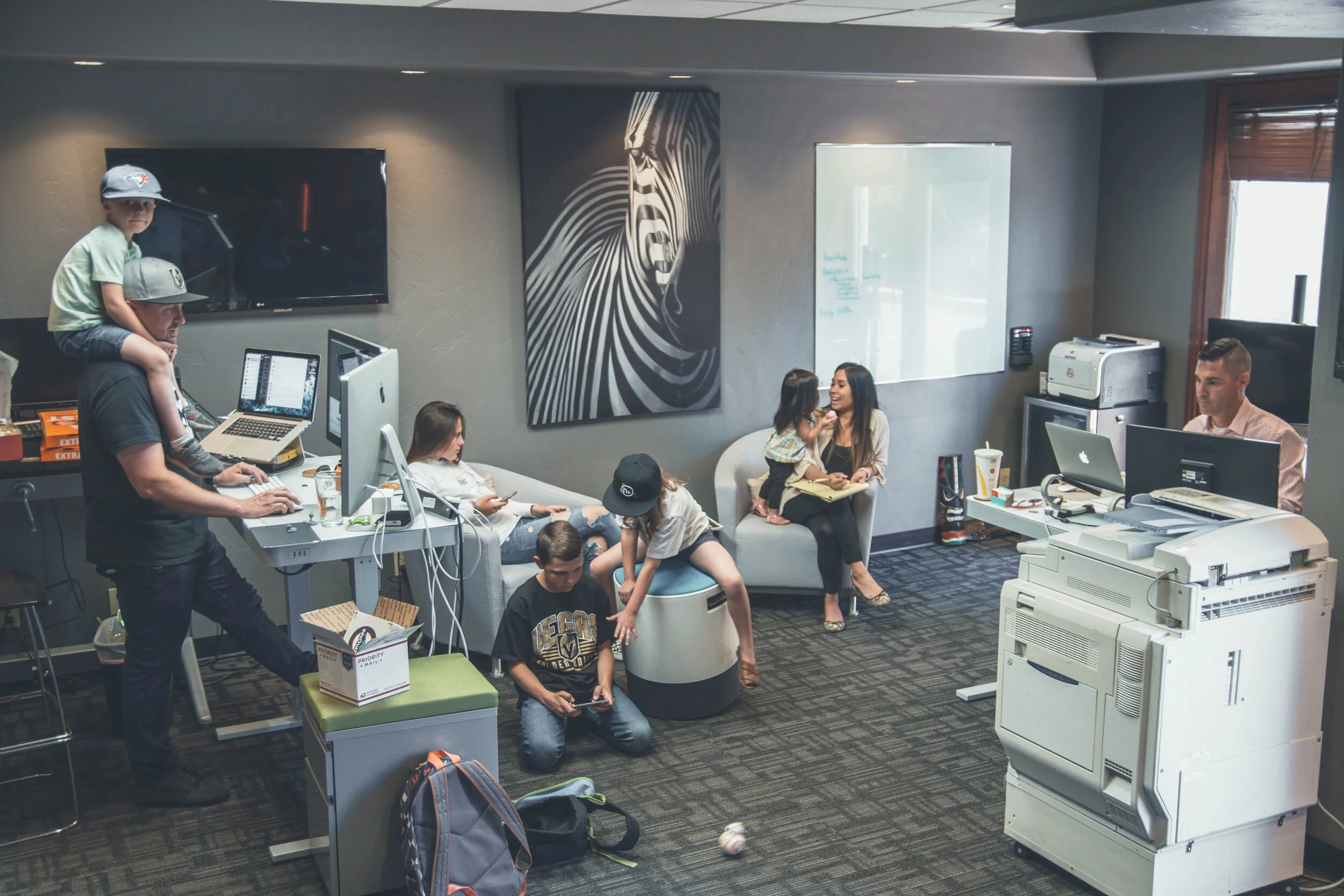
So, given this unexpected and immediate shift to virtual teams during this crisis, we thought we’d share some tips for both managers and employees on how to adjust to working remotely in a home environment.
MANAGERS
1. Clearly define the avenues and rules of communication.
Millennial’s use text as their primary means of communication versus email and phone calls. Does this coincide with corporate policy? Defining this is a top priority.
Don’t send every communication to the entire group. Be selective and intentional so the recipient(s) will pay attention.
2. Try to develop insight into each team members situation.
Don’t assume it’s the same as yours
Do they have school age children at home right now?
Do they have a spouse who was already working from home, so that “office/work space” or even a computer must now be shared?
3. Err on the side of over communication, though keep it short, direct, and respectful, remembering tone is very difficult to express in an email or text (despite the use of emojis).
4. If it’s time sensitive, call them. Voicemail doesn’t mean they are not working.
5. Set realistic time expectations.
Understand some may need to wait until young children are asleep before they can give their undivided attention.
If a project is extremely time sensitive, consider the situation and perhaps reassign, though communicate this accordingly and before making the change.
Be compassionate and understanding to the person having the project taken away and to the one also receiving it. Fears and tensions are running high right now.
6. Treat people as adults. Raise the bar and people will strive to meet it. Treat them like children and they will react accordingly.
EMPLOYEES
1. Set Expectations
Create a work plan. If applicable, communicate with your family or partner first and foremost, and include them in making the plan.
If you have children, are they old enough to entertain themselves? If so, set them down and explain how long you will need to be on a call, to write an email or to simply work. If they can read, write it down and post where easily visible. DO NOT expect teenagers to simply understand.
If children are very young, then you and your partner may need to set-up shifts. The length of shifts depends on work styles and deadlines. It could be that one takes the morning and the other takes the afternoon or perhaps break it up into shorter, 2-hour slots with an hour for lunch.
2. If you don’t have a room for a home office, set up a “quiet zone / work-space”.
Be creative!
It could be in the garage, a walk-in closet or a corner of the bedroom.
Define the space with a table or a desk and other barriers (if possible) such as a bookshelf, blankets or a screen.
3. Set Rules
Whoever has the “quiet zone” for their allotted time are allowed no interruptions unless it’s an emergency
Clearly define emergency, i.e. seriously injured or bleeding = emergency. Disagreements are not.
4. Use visual signs
Have children make the signs for you, this way they are involved. Explain when the sign is on the door/window/chair, they are not to interrupt you without knocking or asking permission first.
Be patient and understand it will still take a few days for them to fully understand and comply.
Take signs down when you’re done working for that time period.
Couples or roommates should also use the sign as a visual reminder to be respectful if they must enter the “quiet zone / work-space”.
5. Set alarms & take breaks
Alarm reminders keep everyone on track and respectful of the “quiet zone / shared space”.
Just because you’re working from home doesn’t make lunch with your partner or kids any less important. Making them a priority helps with expectations and makes them feel important. The more you make time for them, the more likely they are to respect your work time.
Weather permitting, eat or take a walk outside.
6. Communicate with your employer/manager as much as possible.
If you fall into the group of “others at home”, create and propose a plan to overcome your time and space limitations.
If you don’t have assistance with childcare, consider work time adjustments such as getting up early or finishing projects when young children go down for naps or to bed.
For everyone, the key here is trust. Strive to let go of the classic corporate think of “when the cat’s away, everyone will play…”
Managers trust your employees. Employees, honor this trust.
Working virtually and remotely can have its challenges, but if you approach it with a positive attitude, compassion, and a willingness to make adjustments for the unique aspects of a non-controlled office environment, your team can remain cohesive and very productive during this time, and beyond.
And who knows: you may find that some of your team members actually get more done away from the office!